

Table of Contents
- Why Workout Leggings Roll Down: The Real Causes
- How to Tell If Leggings Are Too Small (or Too Big)
- High Waisted Leggings Rolling Down Fix: DIY Solutions That Work
- Choosing the Best Squat Proof Leggings for Women
- How to Prevent Leggings from Rolling Down During Specific Activities
- Proper Care and Washing to Maintain Waistband Elasticity
- Conclusion: Take Control of Your Workout Wardrobe
- Frequently Asked Questions
Last Updated: September 11, 2026
Why Workout Leggings Roll Down: The Real Causes
Learning how to prevent workout leggings from rolling down starts with understanding why it happens. The waistband loses its grip for two main reasons: the fit is wrong, or the fabric has stopped doing its job.
The mechanics are straightforward. A waistband stays put when tension is distributed evenly around a snug fit that matches your waist-to-hip ratio. When that balance tips, gravity and movement win, and the band slides toward your hips mid-squat.
Sizing Mistakes That Cause Slippage
The most common mistake is sizing up to avoid tightness. A waistband that is too loose cannot create the tension needed to stay anchored, so it rolls the moment you move. Sizing down is just as bad: the fabric stretches past its limit, loses elasticity, and sags.
Fabric and Elasticity Problems
Fabric quality decides whether a waistband recovers its shape after stretching. Leggings made with a high spandex or elastane content and four-way stretch hold their fit far better than thin synthetic blends that stretch out and stay stretched.
How to Tell If Leggings Are Too Small (or Too Big)
You can tell leggings are too small if the waistband digs in, leaves red marks, or feels tight before you even move. They are too big if you can pinch more than an inch of fabric at the waist or if the gusset does not sit flush against your body.
Run this quick fit test before your next workout:
- Bend into a deep squat and hold for five seconds. Does the waistband stay level?
- Raise both arms overhead and twist your torso. Does the band roll or fold?
- Check the opacity in a mirror under bright light. Can you see through the fabric at full stretch?
- Walk in place for 30 seconds. Does the waistband creep downward?
If you fail two or more of these, the size, not your body, is the problem.
High Waisted Leggings Rolling Down Fix: DIY Solutions That Work
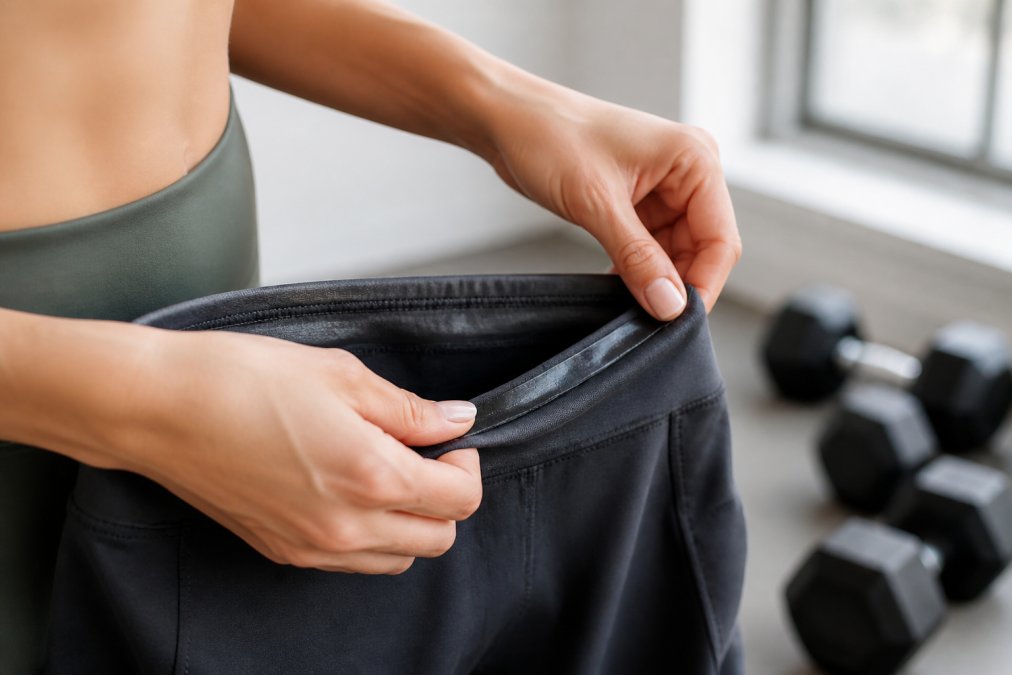
The fastest high waisted leggings rolling down fix is to add friction or tension exactly where the band is sliding. Every DIY fix below works on one of two principles: increasing grip between fabric and skin, or increasing the tension the band can hold. Knowing which principle a fix uses tells you how long it will last and when it will fail.
Grip-Based Fixes (Add Friction)
These work when the band fits but the fabric is slick against your skin. They are temporary and need reapplication, but they are the fastest fix.
- Silicone grip strips: Adhesive-backed silicone tape pressed along the inside of the waistband adds friction without bulk. Expect a few wears per application; body heat and sweat eventually loosen the adhesive. Look for skin-safe, latex-free silicone sold as bra or strap tape.
- Fashion tape: Double-sided body tape at the back seam and both side seams holds the band to your skin or to an underlayer. It is the least visible option under thin fabric, but it releases with sweat, so it suits low-sweat sessions better than HIIT.
- Grippy underlayer: A fitted tank or a high-waist seamless brief tucked under the band gives the waistband something textured to grip. This is the most reliable grip fix for high-sweat workouts because it does not depend on adhesive.
Tension-Based Fixes (Add Hold)
These work when the band is slightly too loose and you need it to stay put without a tailor.
- Fold the band down once: Doubling the fabric thickness increases the band's resistance to rolling. It works best on wide, high-rise bands; on a thin band it just creates a new fold line to roll over.
- Tuck a fitted tank hem into the band: This locks the band against your torso and stops the upward creep that precedes a roll. Choose a smooth, thin hem so it does not create a lump under the leggings.
- Drawstring cinch: If your leggings have an internal drawstring, tighten it to your natural waist (not your hips) and knot it flat. This is the single most effective built-in fix and the reason drawstrings matter on high-impact styles.
Quick Decision Guide
| Situation | Best DIY Fix | Why |
|---|---|---|
| Band fits but slides on smooth skin | Silicone grip strip or grippy underlayer | Adds friction at the contact point |
| Band is slightly loose | Drawstring cinch or fold the band | Adds tension without altering the garment |
| Low-sweat yoga or barre | Fashion tape | Invisible and holds when you are not sweating heavily |
| High-sweat HIIT or lifting | Grippy underlayer or drawstring | Adhesive fails with sweat; tension and texture do not |
| Band has lost its snap | None of these | See the recovery test below |
When to Alter or Replace
If the elastic has visibly stretched and no longer snaps back, no DIY fix will hold for long. A tailor can replace a worn elastic band, but if the fabric itself has lost recovery, replacement may be the smarter spend.
Choosing the Best Squat Proof Leggings for Women
The best squat proof leggings for women combine a wide high-rise waistband, a high elastane content, and a gusset that supports movement without pulling. These three features matter more than brand name or price tag.
GearrUp's High-Waisted Butt-Lifting Yoga Pants are built around exactly these priorities: a tummy-control high waist, premium stretch fabric, and a fit that holds through squats and sprints.

Key Features to Look For
| Feature | Why It Matters | What to Avoid |
|---|---|---|
| Wide high-rise waistband | Distributes tension evenly | Thin, narrow bands |
| High elastane content | Recovers shape after stretching | Low-stretch synthetic blends |
| Four-way stretch | Moves with you in every direction | Two-way stretch only |
| Reinforced seam construction | Prevents seam slippage | Single-stitched seams |
| Squat-proof opacity | Stays covered at full stretch | Thin, see-through fabric |
When you shop, prioritize fit integrity over fashion. A snug fit with real compression beats a loose band every time.
How to Prevent Leggings from Rolling Down During Specific Activities
The right fix depends on the movement pattern, not just the activity name. Rolling is driven by two forces: vertical bounce (jumping, running) and hip flexion (squatting, bending, inversions). Match your waistband to the dominant force and the band stays put.
Match the Waistband to the Movement
| Activity | Dominant force | Waistband that holds | What to avoid |
|---|---|---|---|
| HIIT and plyometrics | Vertical bounce | Wide high-rise band with drawstring or silicone grip | Narrow bands, slick fabrics |
| Heavy lifting and squats | Hip flexion and bracing | High-rise compression band that sits above the hip crease | Low-rise bands that sit at the crease |
| Yoga and barre | Hip flexion and inversions | Tapered high band with a silicone grip strip | Stiff bands that dig in when you fold forward |
| Running and cycling | Repetitive bounce and heat | Moisture-wicking wide band that stays cool | Heavy, heat-trapping bands |
| Everyday and commuting | Sitting and standing | Supportive high waist with moderate compression | Overly compressive bands that roll when you sit |
Why the Movement Matters
- Vertical bounce pushes the band down with every landing. A drawstring or grip strip resists that downward push; a loose band cannot.
- Hip flexion folds the torso at the waist, which is exactly where a low-rise band sits. A high-rise band sits above the crease, so the fold happens below the band instead of through it.
- Heat and sweat reduce friction between fabric and skin, which is why a band that holds in a cool studio can slide in a hot room. Moisture-wicking fabric keeps the contact surface drier and grippier.
Practical Setup by Activity
- HIIT and lifting: Choose high-waist compression tights with a drawstring or anti-slip band. GearrUp's Serpent Aura Sculpt Leggings use moisture-wicking compression fabric built to stay anchored through explosive movement.
- Yoga and barre: A tapered waist with a silicone grip strip prevents rolling during deep bends and inversions without digging in when you fold forward.
- Cycling and outdoor training: Look for moisture-wicking, breathable fabric that will not overheat. GearrUp's High-Waist Tummy-Control Running Shorts use a wide tummy-control band that stays put on long rides without trapping heat.
- Commuting and everyday wear: A sculpting jogger with a supportive high waist transitions from travel to the gym without shifting when you sit and stand.
Proper Care and Washing to Maintain Waistband Elasticity
Washing habits decide how long your waistband lasts. Heat is the enemy of elastane, so cold water and air drying preserve elasticity far longer than hot cycles and tumble drying.


Follow these care rules:
- Wash in cold water on a gentle cycle
- Skip the fabric softener, which coats fibers and reduces stretch recovery
- Turn leggings inside out to protect seam construction and the gusset
- Air dry flat or hang, never tumble dry
- Avoid bleach and high-heat ironing
Conclusion: Take Control of Your Workout Wardrobe
Rolling leggings are often a fit or fabric problem. Fixing the size, choosing high-rise designs with real elastane content, and caring for them properly can help prevent slippage.
When you are ready for gear engineered to stay in place, GearrUp builds precision-crafted activewear with high-waist compression, moisture-wicking fabric, and reinforced construction. Every order includes free shipping, secure payment, and easy returns, so you can test the fit risk-free.
Get started with GearrUp and train with confidence.
American Council on Exercise fitness apparel guidance
Textile exchange fiber and material information
Consumer product care guidance from the Federal Trade Commission
Frequently Asked Questions
Why do my workout leggings keep rolling down?
Workout leggings roll down mainly due to improper sizing, worn-out elastic, or fabric that lacks adequate stretch and recovery. If the waistband is too loose, it cannot grip your waist; if it's too tight, it may fold over. High-waisted designs with wide, compression-style bands and silicone grips are less likely to roll. Also, activities like squats and running increase friction and movement, so choosing leggings with four-way stretch and a snug fit is key.
How can I prevent my leggings from sliding down?
To prevent sliding, start with the right size using a sizing guide and measure your waist-to-hip ratio. Look for high-rise leggings with a wide, tapered waistband and silicone grip or anti-slip technology. Avoid cotton blends that lose shape; instead, choose performance fabrics with spandex or elastane for elasticity and recovery. During workouts, ensure the waistband sits flat against your skin without folding. If needed, use a temporary DIY fix like folding the band or adding a small stitch.
Does sizing up or down help with leggings rolling down?
Sizing down can make the waistband too tight, causing it to roll or dig in, while sizing up often leaves extra fabric that slips. The best approach is to find your true size based on the brand's sizing guide and your measurements. If you're between sizes, consider the fabric's compression level: high-compression leggings may fit snugly without rolling, but if they're too small, they'll still roll. Always test with a squat or bend to check fit integrity.
What features should I look for to prevent waistband roll?
Look for a high-rise waistband that sits above your navel, a wide contoured band, and silicone grip strips inside the waistband. Fabrics with high spandex content (20% or more) and four-way stretch provide better recovery and stay put. Seam construction matters too: flatlock seams and a gusset reduce bulk and improve fit. Moisture-wicking materials keep the fabric from getting heavy with sweat, which can cause slippage. Always check for anti-slip technology or drawstrings for added security.

