

Table of Contents
- Why Sports Bra Chafing Happens During Intense Exercise
- How to Choose the Right Sports Bra Size to Prevent Chafing
- Seam Construction and Fabric Density: What to Look For
- The Best Anti-Chafe Balm for Runners and How to Use It
- How to Wash Athletic Wear to Protect Elasticity and Skin Barrier
- Treating Existing Chafing and Post-Workout Recovery Protocols
- When to Replace Your Sports Bra and Preventative Care Habits
- Frequently Asked Questions
Last Updated: September 20, 2026
Why Sports Bra Chafing Happens During Intense Exercise
Sports bra chafing is skin damage caused by repeated friction, trapped moisture, and pressure from a poorly matched bra. It shows up as stinging, redness, and raw patches under the band, along the ribcage, and where straps sit. This guide breaks down what causes sports bra chafing during intense exercise and how to stop it.
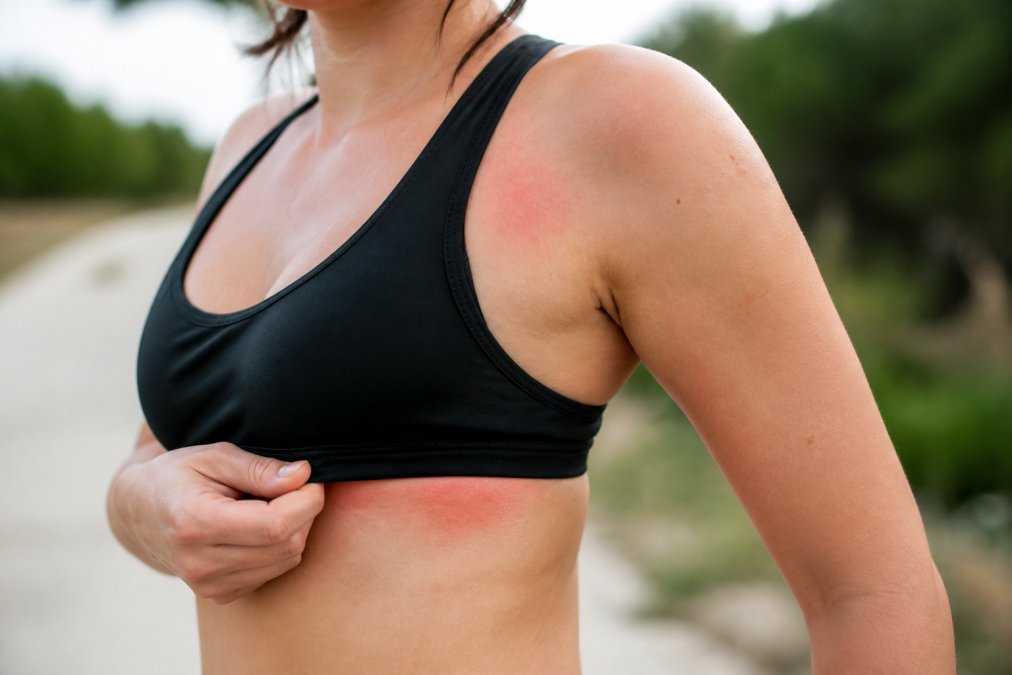
The Friction and Moisture Cycle
Friction alone doesn't cause chafing. Wet skin does.
When sweat accumulates, your skin softens and its barrier weakens, skin maceration. Then even light rubbing from a seam or strap breaks the surface down.
- Dry skin + friction = mild irritation
- Wet skin + friction = raw, painful chafing
- Salt crystals left after sweat dries = extra abrasion
How Body Mechanics and Repetitive Motion Drive Skin Irritation
Running creates thousands of identical movements per hour, pushing your bust up and down while the band shifts against your ribcage.
How to Choose the Right Sports Bra Size to Prevent Chafing
Getting the size right is the single biggest fix. A bra that's too loose slides and rubs. One that's too tight digs in and blocks airflow.
Measuring Your Under-Bust Band and Cup Size
Measure your under-bust band snugly, directly under your bust, in a thin unpadded bra. Round to the nearest whole inch, then measure the fullest part of your bust. The difference gives your cup size: one inch is typically an A, two inches a B, and so on. Do this after a workout, measurements shift with heat and blood flow.
Support Level and Bra-to-Body Ratio for High-Impact Exercise
Support level should match your activity, not your cup size alone.
- Low impact (yoga, walking): light compression is enough
- Medium impact (cycling, weights): compression plus a wider band
- High impact (running, HIIT, jumping): encapsulation or high-compression with a firm band
Seam Construction and Fabric Density: What to Look For
Seam placement decides where chafing starts, but the seam type only tells half the story. The other half is how that seam sits against your breast shape once the fabric is wet and under tension.
Seam Types, Ranked by Friction Risk
- Bonded or ultrasonic-welded seams: No thread, no raised ridge. Lowest abrasion risk. Common in high-end encapsulation bras.
- Flatlock seams: Thread joins fabric with a flat profile. Low risk when new, but the thread can pill and stiffen after repeated washing.
- Overlock (serged) seams: Raised, ridged, and the most common cause of under-band and side-seam chafing. If you feel a bump along the inside of the band, that bump rubs your ribcage for 10,000 strides.
- Coverstitch hems: Found on band edges and strap ends. Usually fine until the elastic fatigues and the hem starts to curl.
Matching Seam Patterns to Breast Shape
A seam that sits on flat skin is harmless. The same seam sitting in a skin fold becomes a cutting edge.
- Shallow or wide-set breasts: Vertical center and horizontal cup seams sit flat. Watch the side seams under the arms instead.
- Full or heavy breasts: Under-bust seams and the inner band edge carry the most load, so a raised seam here chafes first. Look for a wide, seamless under-band panel.
- Close-set or projected breasts: Center-front seams and inner cup edges rub the sternum. A seamless front panel or molded cup eliminates the contact point.
- Asymmetric breasts (very common): The larger side pushes the band down and forward, so the smaller side rides up and slides. Adjustable straps and a hook-and-eye band let you tune each side.
Fabric Density and Fiber Science Under Sweat
Density and fiber type determine how the fabric behaves once wet, and wet behavior drives chafing.
- Denser knits resist stretch, hold shape longer, and keep seams from migrating. Heavier grams-per-square-meter fabric distributes pressure more evenly across the band.
- Thinner knits breathe better but stretch out faster, bunch under the band, and let seams rotate into new friction zones.
Fiber choice matters just as much:
- Polyester: Fastest moisture movement, holds shape well, but can feel slick against dry skin and cause friction when the fit is loose.
- Nylon: Softer, durable, slightly slower to dry than polyester. Often blended with spandex for recovery.
- Spandex (elastane): Provides the stretch that keeps the bra against the body. Too little and it slides; too much and it digs in.
- Cotton: Absorbs sweat and holds it against skin, the worst fiber choice for high-impact chafing. Fine for yoga, wrong for running.
- Merino wool: Moisture-managing and odor-resistant, but expensive and slow to dry. A niche option.
What to Check Before You Buy
In the fitting room:
- Turn the bra inside out. Feel every seam that will touch skin.
- Stretch the under-band panel. It should recover immediately, not stay stretched.
- Check the strap-to-cup junction, the second-most-common chafe zone after the band.
- Look at the side seams under the arms. Raised stitching rubs with every arm swing.
[GearUp's Women's Anti-Shock Sports Bra](https://gearrup.com/products/premium-fixed-integrated-anti-shock-sports-bra) uses a fixed integrated design with bonded construction at the high-friction zones. Fewer raised seams means fewer edges for wet skin to catch on, and the breathable knit moves sweat away from the surface instead of holding it there.

The Best Anti-Chafe Balm for Runners and How to Use It
The best anti-chafe balm for runners stays put through sweat and doesn't clog pores. Look for dimethicone, petrolatum, or shea butter as the base.
Application matters as much as the product:
- Apply to dry, clean skin before you dress
- Cover the under-bust band line, ribcage, and strap paths
- Use a thicker layer for runs over an hour
- Reapply mid-run if you feel stinging start
How to Wash Athletic Wear to Protect Elasticity and Skin Barrier
Residue is the hidden cause of chafing nobody talks about. Detergent left in fabric, plus built-up sweat salts, turns a soft bra into sandpaper.
Wash rules that work:
- Machine wash cold, gentle cycle
- Use a small amount of mild detergent
- Skip fabric softener and dryer sheets entirely
- Air dry when you can
Treating Existing Chafing and Post-Workout Recovery Protocols
Most guides stop at "rinse it and put on some cream." Skin that's been macerated and abraded needs a sequence: stop the friction, cool the tissue, restore the barrier, then protect it while it closes.
Step 1: Get Out of Wet Gear Fast
Sweat-soaked fabric keeps skin macerated and friction going even after you stop. Change within 15 minutes. If you can't shower, swap the bra and blot the area dry with a clean towel, don't rub.
Step 2: Cool and Clean Without Stripping
Rinse with cool water to reduce inflammatory heat and numb the sting. Skip harsh soaps, scrubs, and anything with fragrance, alcohol, or menthol, they feel soothing for 30 seconds, then worsen barrier damage. Pat dry and air dry before applying anything.
Step 3: Match the Ingredient to the Stage
Different ingredients do different jobs, and using the wrong one at the wrong stage slows healing.
For intact but angry skin (red, stinging, not broken):
- Ceramides: Rebuild the lipid barrier sweat and friction stripped away. Look for barrier-repair creams.
- Petrolatum or dimethicone: Create an occlusive layer that locks moisture in and blocks friction. Dimethicone is lighter and less likely to clog pores under a bra.
- Colloidal oatmeal: Reduces itching and irritation. Common in drugstore eczema creams.
- Aloe vera: Cooling and lightly anti-inflammatory. Best as a first layer, not a standalone treatment.
- Shea butter: Rich emollient, good overnight, too heavy under a bra during the day.
For raw or broken skin:
- Zinc oxide: The same ingredient in diaper rash cream. It's mildly astringent, forms a physical barrier, and is the standard recommendation for raw skin folds.
- Plain antibiotic ointment: Use only if the skin is actually broken and there are signs of infection risk. Don't use it as a daily barrier on intact skin.
- Hydrocolloid or thin non-stick dressing: Covers the wound, keeps it moist, and prevents fabric from re-abrading it.
Ingredients to avoid on chafed skin:
- Fragrance and essential oils
- Alcohol and menthol (the cooling burn is not healing)
- Exfoliants and retinoids
- Anything that stings on application
Step 4: Protect While It Heals
- Wear loose, soft clothing over the area for the rest of the day.
- Sleep without a bra, or in a soft, seamless one.
- Skip the next high-impact session, or tape the area with a friction-blocking patch.
- Keep the area clean and dry between applications.
Step 5: Reassess Before the Next Session
If the same spot chafes again within a week, the problem isn't your skin, it's the bra. Repeated chafing in an identical location is a fit or construction signal. Track which bra caused which hot spot and retire it.
When to Replace Your Sports Bra and Preventative Care Habits
Elasticity is the signal. Once a bra stretches out, it stops holding your bust still, and every movement becomes friction.
Replace when you notice:
- The band rides up during runs
- Straps need constant adjusting
- Fabric feels thin or stretched at the seams
- The bra no longer holds shape after washing
Frequently Asked Questions
How do I stop sports bra chafing when running long distances?
Apply an anti-chafe balm to the under-bust band, shoulder strap contact points, and side seams before you run. Choose a sports bra with flatlock seams and moisture-wicking synthetic fabric rather than cotton. Make sure the under-bust band sits snug but not tight, and that shoulder straps stay flat without rolling. If chafing continues past 10K, your bra may be the wrong cup size or support level for high-impact exercise. Replace bras when the band loses elasticity, usually every 6 to 12 months with regular use.
What is the best anti-chafe balm for athletes during high-impact exercise?
Look for a balm with dimethicone, petrolatum, or shea butter as the base. Dimethicone creates a low-friction barrier that lasts through sweat, while petrolatum resists moisture wash-off during long sessions. Stick formulas are easier to apply precisely on strap lines and under the band. Apply before exercise, not after chafing starts. Reapply at aid stations during runs longer than 90 minutes. Avoid scented products on already irritated skin because fragrance can worsen dermatological reactions.
Why does my sports bra chafe only on one side?
One-sided chafing usually points to asymmetry in strap tension or band displacement. Check whether one shoulder strap is tighter or has twisted during wear. A cup size that is slightly too small on one side can also cause skin-on-skin rubbing against the seam. Body mechanics play a role too: if you favor one arm during repetitive motion, that side sees more friction. Adjust straps individually before each workout and consider a bra with adjustable sliders rather than fixed straps.
How do I know if my sports bra is the wrong size?
Three signs: the under-bust band rides up when you raise your arms, the shoulder straps dig in or slide off, and you feel skin-on-skin rubbing under the breasts during high-impact exercise. Measure your ribcage snugly just under the bust for band size, then measure the fullest part of your bust for cup size. The difference in inches determines cup. Replace your bra if the band has stretched enough that you need to start on the tightest hook.
Chafing is a gear problem, and gear problems have gear solutions. GearrUp builds sports bras with high-elasticity fabric, shock-absorbing construction, and flat, low-friction seams, so your skin isn't the thing absorbing the impact. With free shipping, secure payment, and easy returns, trying the right fit costs you nothing but a click. Get started with GearrUp and train without the sting.

