

Table of Contents
- Why the Resistance Band Is a Teaching Tool, Not a Crutch
- What You'll Need Before Your First Banded Rep
- Muscle Up Progression Exercises That Build the Transition
- How to Set Up a Resistance Band for Muscle Ups
- How to Choose Resistance Band Thickness for Pull Ups and Muscle Ups
- Muscle Up Training Program for Beginners: A 6-Week Roadmap
- Fixing the Chicken Wing and Other Common Form Faults
- Warm-Up and Mobility Prep for Muscle Up Training
- Gear That Supports Your Progression
- Frequently Asked Questions
Last Updated: September 26, 2026
Why the Resistance Band Is a Teaching Tool, Not a Crutch
A resistance band for muscle up training gets a bad reputation as cheating. That view is wrong.
What You'll Need Before Your First Banded Rep
You need a few basics before you start, or you will waste weeks.
Equipment checklist:
- A straight pull-up bar (not angled handles)
- A set of loop resistance bands in light, medium, and heavy
- Chalk or a good grip aid
- A phone tripod for form checks
- A warm-up routine (covered later)
Muscle Up Progression Exercises That Build the Transition
The transition, the moment your body shifts from pulling to pushing, is where most people fail. These drills target it.

Phase 1: Explosive Pull and Straight Bar Strength
Build raw pull power first. This phase takes 2-3 weeks.
- Explosive pull-ups: Pull as high as you can, aiming to get your chest to the bar
- Straight bar dips: Keep your body close to the bar and press up
- Scapular retraction holds: Hang and pull your shoulder blades down and back
- Lat activation drills: Slow, controlled pulls that focus on your lats
Phase 2: False Grip and Transition Drills
The false grip makes the transition possible.
- False grip hangs: Grip the bar with your wrists over the top, not your fingers
- False grip rows: Pull your chest to the bar from a low position
- Transition negatives: Start at the top and lower slowly through the transition
- Band-assisted transitions: Use a light band to practice the shift
Phase 3: Banded Full Reps and Eccentric Work
Now put it together: full reps with band help, then slow negatives.
- Banded muscle ups: 3 sets of 3-5 reps with a medium band
- Eccentric muscle ups: Jump to the top, lower for 5 seconds
- Consecutive reps: Work toward 2-3 in a row
How to Set Up a Resistance Band for Muscle Ups
Setting up a resistance band for muscle ups takes about 30 seconds once you know the method, and gets the band helping exactly where you need it.
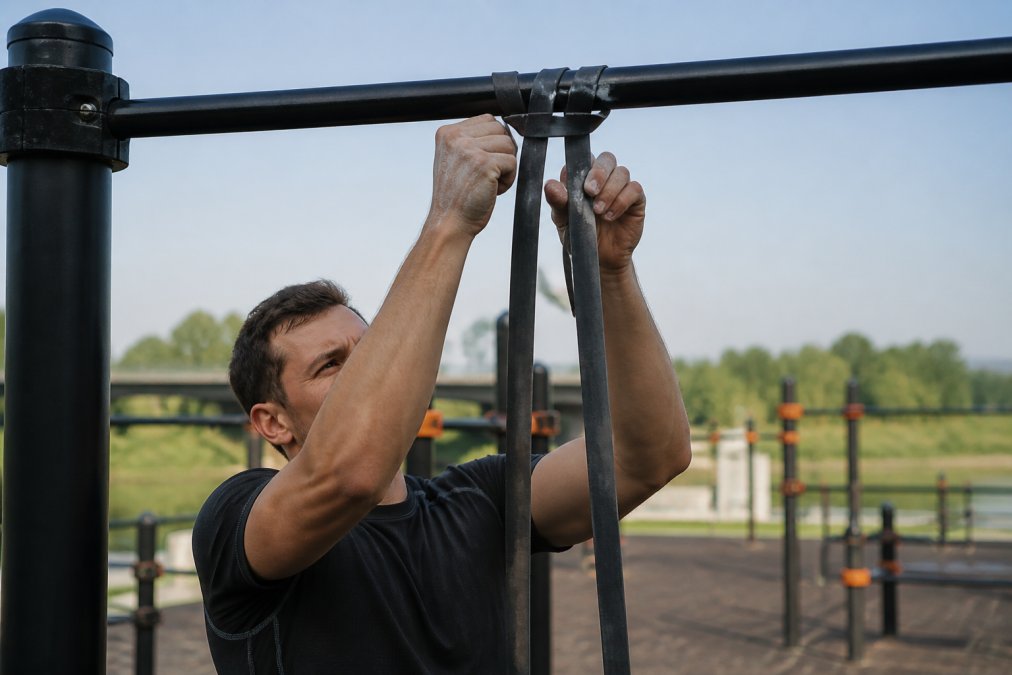
- Loop the band over the pull-up bar so both ends hang evenly
- Pull the bottom of the band down and step one knee or foot into it
- Position the band under your knee for more help, or under your foot for less
- Grip the bar and hang, checking that the band is centered
- Do one slow test rep before your working sets
How to Choose Resistance Band Thickness for Pull Ups and Muscle Ups
Choosing resistance band thickness comes down to one test: can you complete the rep with good form but still feel challenged? If yes, that band is right. The real skill is knowing when to move down a level, and most guides never give you a schedule for that.
Match the Band to the Phase, Not the Ego
Bands are sold by color and approximate tension at a given stretch. Because tension rises as the band stretches, the same band gives more help at the bottom of the pull (where you are weakest) and less at the top (where you are strongest), exactly the assistance curve you want. Treat the tension numbers as approximate, brands label differently, so test each band with one slow rep before you commit.
| Band Level | Approx. Tension at Working Stretch | Best For | Working Rep Range |
|---|---|---|---|
| Light | 15-35 lb | Transition drills, false grip work, eccentric control | 5-8 reps |
| Medium | 30-60 lb | Full banded muscle ups, consecutive reps | 3-5 reps |
| Heavy | 50-100+ lb | Early pull-up strength, warm-ups, high-volume pull work | 8-12 reps |
The Band-Tension Progression Roadmap (The Part Most Guides Skip)
This deload schedule turns a band from a crutch into a ladder. The rule: move down a band level only when you hit the top of the rep range with clean form on two separate sessions. Never move down mid-session because a rep felt easy, fatigue and adrenaline both lie.
Stage 1, Heavy band, high reps (Weeks 1-2)
- 3 sets of 8-10 banded pull-ups and 3 sets of 8-10 banded dips
- Goal: groove the pull-to-push path and build work capacity
- Move down when: 3x10 feels controlled with no kipping
Stage 2, Medium band, transition focus (Weeks 3-4)
- 4 sets of 3-5 banded muscle ups, plus 3 sets of 3 transition negatives
- Goal: own the transition with the band taking the edge off
- Move down when: 4x5 banded reps are clean and your elbows stay close
Stage 3, Light band, full reps (Weeks 5-6)
- 4 sets of 3-5 banded muscle ups, plus 3 sets of 3 eccentric-only reps
- Goal: approach unassisted strength while keeping the pattern honest
- Move down when: 4x5 light-band reps are clean and you can hold a 5-second eccentric
Stage 4, No band, singles (Week 7+)
- 5-8 sets of 1 unassisted rep, resting 2-3 minutes between attempts
- Keep one light band nearby for a back-off set if form breaks
The Deload Rule
Every 3-4 weeks, cut banded volume in half for one week while keeping the same band. Do not move down a level during a deload, the point is recovery, not progression. Skipping deloads is the fastest way to stall at the same band for months.
How to Test Whether the Band Is Too Heavy
Film your reps from the side. If the band does most of the work at the top, you pop over the bar with no pressing effort, it is too heavy. A second test: pause one second at the transition. If you cannot hold that position, the band is carrying you.
Muscle Up Training Program for Beginners: A 6-Week Roadmap
A muscle up training program for beginners should build strength and skill at once. Here is a 6-week plan that does both.
Weeks 1-2: Foundation
- 3 sessions per week
- Explosive pull-ups: 4x5
- Straight bar dips: 4x5
- Scapular holds: 3x20 seconds
Weeks 3-4: Transition Focus
- 3 sessions per week
- False grip hangs: 3x15 seconds
- Transition negatives: 3x3
- Banded transitions: 3x3
Weeks 5-6: Full Reps
- 3 sessions per week
- Banded muscle ups: 4x3
- Eccentric muscle ups: 3x3
- Consecutive rep attempts: 3x2
Fixing the Chicken Wing and Other Common Form Faults
The "chicken wing" fault is the most common muscle up mistake: one arm extends before the other, the rep stalls, and you either grind it out or drop. Most guides call it a strength imbalance and prescribe single-arm rows. That is only half the story.
What Actually Causes the Chicken Wing
The chicken wing is a timing fault first and a strength fault second. During the transition, both elbows must rotate from a pull (elbows down) to a press (elbows up and back) at the same moment. If one side initiates a fraction earlier, that arm takes the load, the other lags, and the bar drifts to your stronger side, the wing.
Three things drive it:
- Asymmetric grip: One hand sits deeper in the false grip than the other, so one wrist is already ahead.
- Uneven scapular pull: One shoulder blade retracts before the other, tilting your torso.
- Rushed transition: The faster you try to muscle through, the more your dominant side takes over.
How Band Placement Fixes the Chicken Wing
Most guides skip this: you can use band placement as a corrective, not just an assist.
A Two-Week Chicken Wing Fix
- Sessions 1-3: Light band, offset toward the weaker side, 4x3 paused transition reps
- Sessions 4-6: Light band, centered, 4x3 paused transition reps, plus 3x8 single-arm rows per side
- Sessions 7-9: Medium band, centered, 4x3 full banded reps, plus 3x8 single-arm rows per side
- Sessions 10-12: Light band, 4x3 full reps, then 3x1 unassisted attempts
If the wing returns when you remove the band, you moved down too early. Go back one stage for a week.
Other Common Faults and Their Fixes
- Kipping too early: Build strict strength first. A small hip drive is fine to finish a rep; a big swing that replaces the pull is not. If your hips lead the pull, drop to a heavier band and slow down.
- Losing the false grip: Re-grip before you pull, not during. If your wrist rolls out mid-rep, your false grip is not deep enough, practice false grip hangs until you hold 20 seconds comfortably.
- No hip drive: A small, well-timed hip drive helps the transition. Time it as your chest reaches the bar, not before.
- Rushing reps: Speed hides bad form. Slow the eccentric to 3-5 seconds and the fault shows immediately.
- Bar drifting away: Keep the bar close through the pull. If it drifts forward, your lats are not engaged, add scapular retraction holds.
Warm-Up and Mobility Prep for Muscle Up Training
Warm-up routines for muscle up prep protect your shoulders and wrists. Cold tissue tears. Warm tissue performs.
5-minute warm-up:
- Arm circles: 30 seconds each direction
- Band pull-aparts: 2x15
- Wrist circles and stretches: 1 minute
- Scapular pull-ups: 2x10
- Dead hangs: 2x20 seconds
Mobility focus areas:
- Shoulder girdle: wall slides and band dislocates
- Wrists: gentle flexion and extension stretches
- Lats: overhead reaches and side bends
- Thoracic spine: cat-cow and thread-the-needle
Gear That Supports Your Progression
Your equipment should keep up with your training. Cheap bands snap. Poor bars spin. You do not want either mid-rep.
Frequently Asked Questions
How do you set up a resistance band for muscle ups?
Loop the band over the center of a straight bar and pull both ends down so they hang evenly. Step one foot or knee into the loop, then grip the bar with a false grip. The band should be slack at the bottom of your hang and fully stretched at the top of the transition. Check that the band sits centered so it pulls you straight up, not sideways. Replace any band with nicks or thinning latex before your next session.
Which resistance band thickness is best for learning muscle ups?
Start with a light band that removes roughly 15 to 35 pounds of your bodyweight. If you can already do 8 strict pull-ups, a light band is usually enough to groove the transition. Heavier bands make the movement easier but teach poor mechanics because the band does too much of the work. Move down a resistance level once you complete 5 clean banded reps without the chicken wing fault.
How long does it take to learn a muscle up with band assistance?
Most lifters who already have 8 to 10 strict pull-ups and 10 solid dips need 6 to 12 weeks of consistent banded practice. Train the progression 2 to 3 times per week with 4 to 6 sets per session. The timeline depends on your explosive pull-up height and how quickly you learn the transition phase. Deload every fourth week to let your shoulders and elbows recover.
Do resistance bands actually work to build muscle for pull-ups?
Bands build muscle indirectly by letting you perform more reps and train the movement pattern more often. They reduce the load at the bottom of the pull, which helps you accumulate training volume and practice the transition. For raw strength, pair banded work with heavy weighted pull-ups and eccentric training. Bands alone will not replace progressive overload on strict reps.
The muscle up is one of the hardest calisthenics skills to learn, and the transition is where most athletes stall. The right resistance band for muscle up training removes just enough weight to let you practice the movement with clean form. GearrUp makes that easier with durable, color-coded bands built for pull-up and strength training, plus free shipping and easy returns. Get started with GearrUp and turn your first banded rep into your first unassisted muscle up.

