

Table of Contents
- Why Look for a Play It Again Sports Alternative for Gym Equipment?
- New vs Used Gym Equipment Pros and Cons: What Actually Matters
- 7 Best Places to Buy Used Gym Equipment
- How to Inspect Used Fitness Gear Like a Pro
- GearrUp Fitness Equipment Reviews: A Direct Alternative Worth Your Money
- The Verdict: Build Your Home Gym Without the Risk
- Frequently Asked Questions
Last Updated: September 4, 2026
Why Look for a Play It Again Sports Alternative for Gym Equipment?
The hunt for a play it again sports alternative for gym equipment usually starts the same way: you want serious gear without paying retail prices, and you assume a second-hand chain is the only stop worth making. That assumption costs you time and, often, money. Between inconsistent inventory, unpredictable condition of pre-owned machines, and the sheer effort of hauling a used treadmill home only to find a worn belt, the local resale route has real drawbacks.
At GearrUp, we spend our days thinking about how people build durable home gyms. Buying used gym equipment is a viable strategy, but it works best when you treat it as one option among several, not the default. Below, we walk through the honest tradeoffs of new versus used gear, rank the seven best places to shop, and give you a safety inspection checklist.
But first, here is what most guides get wrong: they assume "used" is automatically cheaper. Once you factor in shipping costs, replacement parts, and the value of your time inspecting and hauling bulky cardio equipment, the gap between a bargain and a new, warrantied piece of fitness equipment narrows considerably.
New vs Used Gym Equipment Pros and Cons: What Actually Matters
The decision between new and used gym equipment comes down to two questions: how much risk you can absorb, and how long you plan to keep the gear. Used equipment wins on upfront price, which is why treadmills, ellipticals, and stationary bikes dominate the second-hand market. The FTC's guidance on used product purchases reminds buyers that warranty protections for second-hand goods vary widely by seller, so the lowest price tag can carry hidden exposure.
What the pros and cons lists rarely capture is the maintenance reality. A used treadmill may have thousands of miles on its deck and belt, which are wear items that cost real money to replace (peer-reviewed research). Strength training equipment like free weights and squat racks, by contrast, are nearly indestructible, making them the safest second-hand purchases. Cardio equipment with motors and electronics is where the risk concentrates.
| Factor | Used Equipment | New Equipment |
|---|---|---|
| Upfront cost | Lower, but variable | Higher, predictable |
| Warranty | Often none or limited | Included, full coverage |
| Wear risk | High for cardio, low for steel | None |
| Assembly | Often required, no support | Often included or guided |
| Resale value | Depreciates slowly | Depreciates fast initially |
Your tolerance for assembly and maintenance should drive the decision. If you are comfortable tightening bolts and replacing a treadmill belt, used commercial-grade gear can be a legitimate score. If you want to unbox, set up, and lift, the premium for new equipment buys you peace of mind and a warranty that protects your investment.
7 Best Places to Buy Used Gym Equipment
Shopping for a play it again sports alternative for gym equipment means knowing which channels give you the best combination of price, condition, and recourse. Not all sellers are equal, and the platform you choose determines how much protection you have if something goes wrong. Here is the honest breakdown of each channel.
-
GearrUp (new, warrantied equipment) - Our top pick for most buyers, because you eliminate condition risk entirely. The GearrUp Power Cage Home Gym Rack at $399.99 handles a 1,000-lb capacity with a compact footprint, giving you commercial-grade strength training without the gamble of unknown wear.

GearrUp Power Cage Home Gym Rack -
Facebook Marketplace - The best local option for bulky items like treadmills and squat racks. You can inspect in person, but there is zero buyer protection and no return policy. Facebook will not mediate a cash transaction. Meet in a public place for smaller items; for large equipment, bring a friend and go during daylight hours. Negotiation is expected: most sellers price items 15-20% above what they will accept, so a respectful offer at 80% of the asking price is a reasonable starting point.
-
OfferUp - Similar to Marketplace, with a rating system that helps you gauge seller reliability. Still, you are buying as-is. OfferUp's in-app payment feature provides some transaction records, but it does not offer the purchase protection of a credit card. Check the seller's response time and history; a seller with 50+ completed transactions and a 4.8-star rating is far safer than a new account with no history. Items listed for over three weeks are often priced too high, and sellers are more willing to drop the price.
-
Craigslist - The deepest inventory for commercial-grade used equipment, often from gyms closing down. Prices are negotiable, but scams require vigilance. The classic red flags are sellers who refuse to meet in person, request payment via wire transfer or gift card, or list a $2,000 treadmill for $300 with stock photos. Legitimate gym liquidation sales will let you visit the facility during business hours. For private sellers, insist on seeing the equipment in person before paying.
-
eBay - Strong for accessories, free weights, and smaller gear. Buyer protection exists, but shipping costs on heavy items can erase savings. Before bidding, check the seller's feedback score and read the condition description carefully. "Used" on eBay can mean anything from "lightly used for a month" to "pulled from a dumpster." Look for listings with multiple photos showing the item from all angles, and ask the seller directly about wear items like belts, cables, and upholstery. A 50-lb dumbbell set might cost $30-50 to ship, but a 200-lb treadmill will cost $200-400, which often makes local pickup the only sensible option.
-
Play It Again Sports - Worth checking for franchise consistency, but inventory is location-dependent and turnover is unpredictable. The advantage here is that items are typically inspected by staff before being put on the floor, and some franchises offer a limited return window. However, prices are often only 30-40% below retail, which is less aggressive than private sellers. Ask the staff about the item's history: how long it was in the store, whether it came from a gym or a home, and what condition it was in when it arrived.
-
Garage sales and estate sales - The cheapest source for free weights and benches, though condition and selection are pure luck. The best time to shop is Saturday morning, when most sales are fully stocked. Estate sales, often run by professional companies, are a hidden gem for commercial-grade equipment from older homeowners who maintained their gear meticulously. Prices are negotiable, especially on the final day of a multi-day sale when sellers are eager to clear inventory.
Online Marketplaces vs Local Sellers: The Logistics Tradeoff
The real difference between online and local channels is logistics, not price. Local sellers let you inspect and avoid shipping, but you handle transport, assembly, and any repairs yourself. Online marketplaces offer buyer protection and delivery, yet shipping costs on a 200-lb treadmill can run into the hundreds of dollars, quietly eliminating the discount that made used gear attractive.
A common mistake is fixating on the listed price while ignoring the total cost. Before you commit to a local pickup, ask yourself whether you have a vehicle that can transport the item, help to load it, and a path to get it into your gym space. For strength training equipment, the effort is often worth it. For cardio machines with delicate electronics, the risk of damaging the unit during transport is a real concern.
When comparing online versus local, factor in the hidden costs of each. Local pickup requires a truck or SUV with a flat load floor, a ramp or lift gate, and at least one strong helper. A 300-lb squat rack will not fit in a sedan, and renting a truck from Home Depot costs about $20 for 75 minutes plus mileage. Online purchases include shipping, but also include the convenience of delivery to your door. For items over 150 lbs, freight shipping is the norm, and you should confirm whether the seller offers lift-gate service or if you need to unload the pallet yourself. A freight delivery to a residential address typically adds $50-150 to the total cost.
How to Inspect Used Fitness Gear Like a Pro
The inspection is where you separate a legitimate deal from a costly mistake. Most people show up, glance at the equipment, and hand over cash. A proper inspection takes twenty minutes and covers the frame, the moving parts, and the electronics. But what happens when you find a problem? Most guides stop at "walk away," which ignores the reality that some issues are cheap fixes while others are deal-breakers.
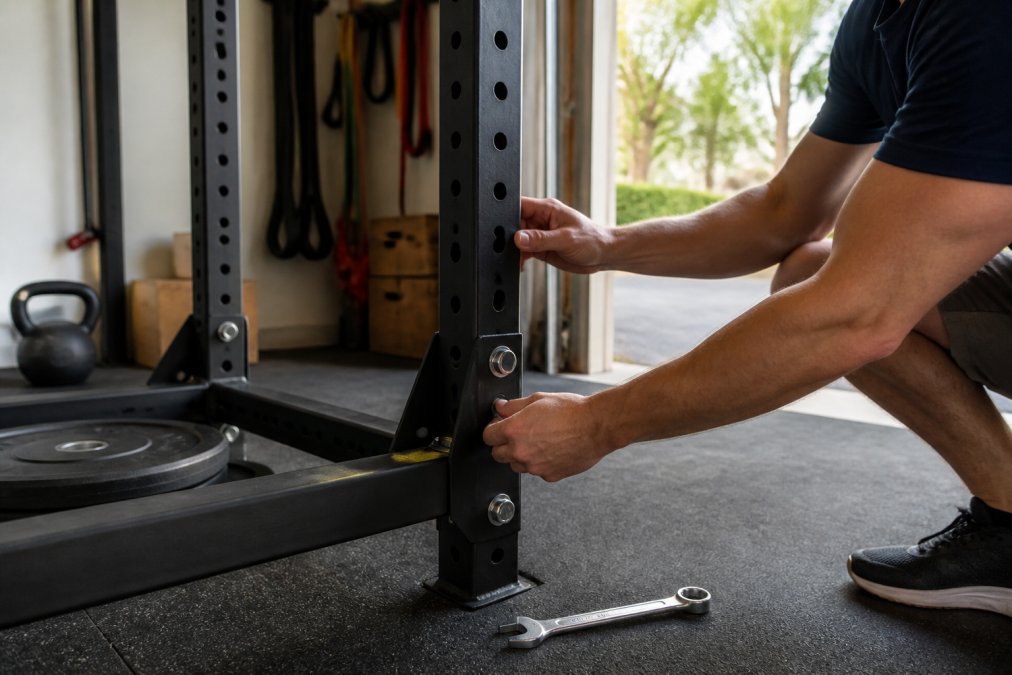
Start with the frame. Look for rust, cracks, or signs of welding repairs, which indicate structural compromise that no amount of cleaning will fix. Check every bolt and joint for tightness. A wobbly frame on a squat rack or power cage is a hard pass, regardless of price, because the failure mode is catastrophic. Surface rust on a frame is cosmetic and can be treated with a wire brush and rust-inhibiting paint, but deep pitting or flaking metal indicates the steel has lost its structural integrity.
Safety Inspection Checklist for Cardio and Strength Equipment
For cardio equipment, the checklist is specific. Walk on the treadmill belt and feel for flat spots or slipping. Listen for grinding from the motor. Check the incline mechanism. On a stationary bike, test the resistance and look for play in the pedals and crank arm. Ellipticals should move smoothly through their stride with no clicking from the bearings.
For strength training gear, the priorities shift. Free weights should be checked for cracks or chips. Benches need a stability test: sit on them and shift your weight to see if they wobble. A squat rack or power cage requires the most scrutiny because it bears the heaviest loads. Inspect the J-hooks and safety bars for bending or wear, as these components take the brunt of failed reps.
Cleaning and Sanitizing Protocols for Second-Hand Gear
Sanitization is the step everyone skips, and it matters more than you think. Used gym equipment carries years of accumulated sweat, bacteria, and grime. The EPA's guidance on disinfectants for public spaces lists the disinfectants proven effective against common pathogens, and you should use them on every surface before the equipment enters your home.
Wipe down all surfaces with a disinfectant appropriate for the material. Avoid bleach on padded upholstery, as it degrades the material. Use a mild detergent and water for the frame, then follow with a disinfectant spray. For cardio equipment, pay special attention to the handles, console, and heart rate sensors, which are high-touch areas. Allow everything to dry completely before use.
What You Can Repair vs. What You Should Walk Away From
This is the part most guides skip. Not every flaw is a deal-breaker, and knowing the difference between a $20 fix and a $300 repair can turn a so-so deal into a legitimate score.
Repairable at home for under $50:
- Treadmill belt replacement - A new belt costs $30-60 depending on the model. If the belt is worn but the deck is still smooth, you can replace it with basic hand tools in about an hour. Watch a tutorial specific to your model before buying.
- Loose bolts and hardware - A socket set and thread-locking compound solve most wobble issues. Tighten everything, apply thread-locker to the bolts, and the machine will feel solid again.
- Squeaky pulleys and rollers - Silicone spray lubricant, not WD-40, on the pulley bearings eliminates most squeaks. WD-40 degrades rubber and will make things worse.
- Upholstery tears - A vinyl repair kit from an auto parts store costs $10-15 and makes small tears nearly invisible. For larger damage, replacement pads are available from the manufacturer.
Repairable with moderate effort and $100-200 in parts:
- Treadmill deck replacement - If the deck is worn but the motor is healthy, a new deck costs $100-200. This is a two-person job that takes a few hours.
- Cable and pulley replacement on cable machines - Steel cables wear out after years of use. Replacement cables cost $20-50 each, and the job requires basic mechanical skills and patience. If the cable is frayed, do not use the machine until it is replaced.
- Console replacement on cardio equipment - If the display is dead but the motor works, a replacement console from the manufacturer costs $100-300. Check if the part is still in production before buying the machine.
Walk away, regardless of price:
- Motor failure on treadmills or ellipticals - A replacement motor costs $200-500 plus labor. This is rarely worth it on a used machine.
- Structural cracks or welds that have failed - No repair is safe. The metal has fatigued and will fail again under load.
- Electronics with water damage - Corrosion on circuit boards is not fixable. The machine will have intermittent issues that drive you crazy.
- Hydraulic systems on adjustable benches - If the hydraulic lift fails, replacement parts are often discontinued and impossible to find.
GearrUp Fitness Equipment Reviews: A Direct Alternative Worth Your Money
When you weigh the inspection time, transport logistics, and repair risk of used gear, new equipment from GearrUp frequently comes out ahead on total value. The honest criticism of new equipment is the higher upfront price. The honest answer is that you are buying certainty.
GearrUp fitness equipment reviews from our customers consistently highlight three things: durability under heavy use, fair pricing, and the convenience of free shipping with easy returns. The Multifunction Home Gym System - 99 lb Weight Stack at $499.99 replaces an entire room of single-purpose machines, supporting over 35 exercises in a compact footprint. For those building a serious strength training setup, the Multi-Use Power Cage for Home Gym - Adjustable Rack at $1,499.00 offers a sturdy 2" x 2" steel frame with adjustable height settings, a pull-up bar, and a cable attachment.


The value proposition is simple: a new, warrantied power cage costs less than a used one plus the replacement parts and repair labor it will likely need. The Olympic Weight Bench with Squat Rack at $199.99 and the Multi-Function Squat Machine for Home Gyms at $139.99 round out a budget-friendly home gym that requires zero inspection skills and zero guesswork.
The Verdict: Build Your Home Gym Without the Risk
Shopping for a play it again sports alternative for gym equipment is ultimately a risk management exercise. Used gear can save you money on the right items, particularly free weights and heavy-duty steel structures that do not wear out. But for cardio equipment with motors, and for any gear where structural integrity is critical, the savings rarely justify the uncertainty.
The most reliable path to a home gym you can trust is to buy new from a brand that stands behind its products. GearrUp offers precision-crafted equipment built for intense training sessions, with free shipping, secure payment, and easy returns that remove the risk from your purchase. Whether you choose the Power Cage Home Gym Rack or the Multifunction Home Gym System, you get commercial-grade durability at fair prices, without spending a weekend inspecting someone else's castoffs.
Get started with GearrUp and build a home gym that performs from day one.
Frequently Asked Questions
Does Play It Again Sports negotiate prices?
Yes, Play It Again Sports stores often negotiate prices on used items, but the wiggle room depends on the franchise owner, the item's condition, and how long it has been in inventory. Their stock is inconsistent, making it hard to find specific equipment. This unpredictability is a key reason many shoppers explore other gym equipment alternatives where pricing is transparent and inventory is guaranteed.
What is the best budget home gym equipment?
The best budget home gym equipment depends on your space and goals. For strength training, a multi-function squat machine or an Olympic weight bench with a squat rack offers the most value per dollar. These pieces support squats, presses, and rows without needing multiple machines. If you have more room and a higher budget, a power cage with a 1,000-lb capacity is a durable long-term investment. Always prioritize equipment with heavy-duty steel construction over cheaper, lighter frames.
Is buying used gym equipment worth the risk?
Buying used gym equipment can save you money off retail, but it carries risks. The biggest concerns are hidden frame damage, worn cables, and rust that compromises safety. Unlike new gear, used items rarely come with a warranty, and return policies are often final sale. If you buy used, inspect the frame for cracks, test all moving parts, and ask about the seller's maintenance routine. For critical safety items like power racks, the peace of mind of a new, warrantied product often justifies the extra cost.
Where can I find reliable used gym equipment online?
Reliable online sources for used gym equipment include Facebook Marketplace, Craigslist, and OfferUp for local pickups, and eBay or specialized fitness resellers for shipped items. The key is verifying the seller's reputation and asking for detailed photos and videos of the equipment in use. Local marketplaces let you inspect items in person, but online resellers often provide better return policies. Always factor in shipping costs, which can add $100-$300 for large items like treadmills or power racks.
How do I verify the quality of used fitness gear before buying?
Start by asking the seller for the brand, model, and purchase date, then look up the original retail price and any known recalls. When you inspect the item, check the frame for cracks or welds that look repaired, test cables for fraying, and listen for unusual noises from the pulley system. For cardio equipment, run the machine for 10 minutes to ensure the motor runs smoothly. Ask to see the equipment in person whenever possible, and never buy a power rack with a bent or twisted frame.
This article was written using GrandRanker

