

Table of Contents
- How Compression Socks and Regular Socks Differ
- Benefits of Compression Socks for Runners
- What the Evidence Says About Performance and DOMS
- How Long to Wear Compression Socks for Recovery
- Compression Socks vs Calf Sleeves: Which Fits Your Run
- When to Skip Compression: Contraindications and Risks
- Frequently Asked Questions
Last Updated: September 24, 2026
How Compression Socks and Regular Socks Differ
Compression socks apply graduated compression to your lower leg, while regular socks simply cover the foot and ankle with no pressure gradient. That difference in construction is what separates a running recovery tool from a basic layer of fabric.
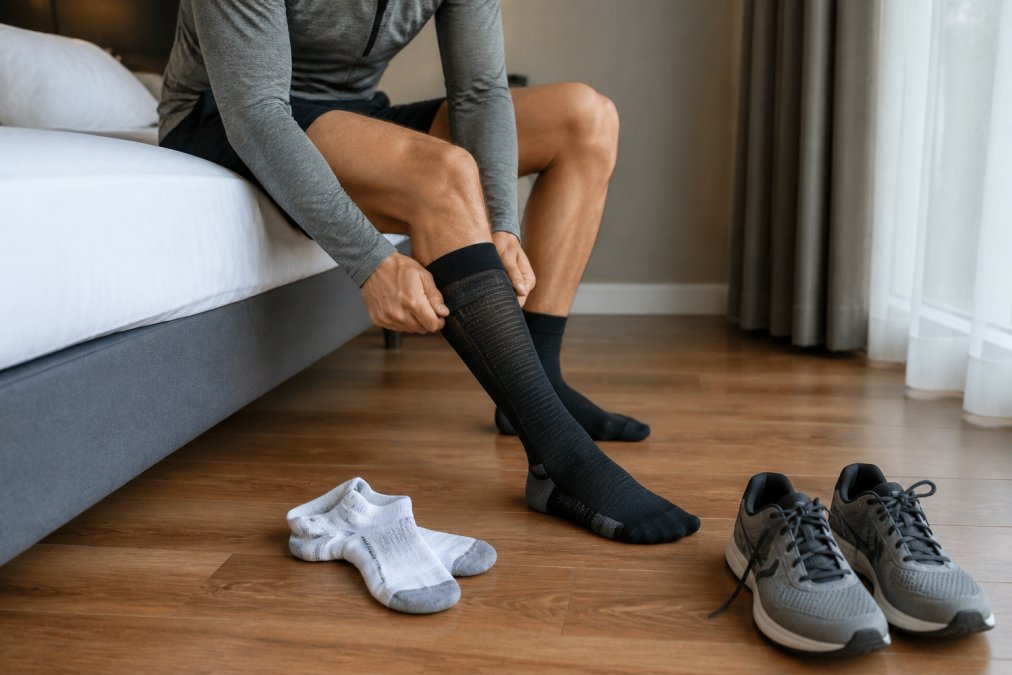
A graduated sock is tightest at the ankle and loosens as it climbs toward the calf. Regular athletic socks are knit to one uniform tension from top to bottom. According to Cleveland Clinic overview of compression therapy, that engineered pressure gradient is the entire point: it assists venous return rather than just cushioning the foot.
Gear should do a job, not just sit on your body. A sock that never changes tension can't influence blood flow. A sock with a compression profile can.
The Pressure Gradient: What Graduated Compression Actually Does
Graduated compression is a measured pressure difference between the ankle and the calf, usually described in millimeters of mercury, or mmHg. The highest pressure sits at the ankle; the lowest sits near the top of the sock.
| Feature | Compression Socks | Regular Socks |
|---|---|---|
| Pressure | Graduated, ankle to calf | None |
| Measured in | mmHg | Not applicable |
| Main job | Circulatory support | Cushioning, warmth |
| Best for | Recovery, long runs | Everyday wear |
Benefits of Compression Socks for Runners
The core benefit for running recovery is circulatory support after hard efforts. Runners commonly report that compression helps legs feel less heavy in the hours following a long run, though individual results vary widely.
Blood Flow, Venous Return, and Metabolic Waste Clearance
Venous return is the flow of blood from your legs back to your heart. Compression supports this by applying external pressure that works with your veins instead of against them.
What the Evidence Says About Performance and DOMS
The evidence splits cleanly into two buckets, and conflating them is why so much compression marketing feels slippery. During-run performance is the weak bucket. Post-run recovery is the stronger one.
- Delayed onset muscle soreness (DOMS), peak soreness 24 to 72 hours after unaccustomed or eccentric-heavy effort
- Creatine kinase (CK), a blood marker of muscle damage that spikes after hard downhill or long efforts
- Perceived recovery, how fresh runners rate themselves the next morning
- Swelling (edema), measurable girth change in the lower leg
Why DOMS Isn't Lactic Acid
DOMS is microscopic muscle damage and the inflammatory response that follows it, not lactic acid. Lactate clears from the bloodstream within roughly an hour of finishing a hard effort, so it cannot explain soreness that peaks two days later. This is one of the most persistent myths in running, and it's worth correcting because it changes what you expect compression to do.
Muscle Oscillation and the Vibration Damping Theory
Muscle oscillation is the second mechanism. During running, your calf muscles vibrate with every foot strike, roughly 160 to 180 times per minute at a typical cadence. Compression garments damp that vibration, which in theory reduces the eccentric load on muscle fibers and the connective tissue around them. This is the same principle behind the vibration-damping claims in some shoe foams, applied to fabric instead.
What Compression Won't Do
Be skeptical of any claim that compression:
- Replaces sleep, protein intake, or a proper cool-down
- Fixes a training error (too much volume, too fast a ramp)
- Speeds healing of a diagnosed muscle strain or tendon injury
- Produces measurable race-day speed gains for most recreational runners
A useful mental model: compression is a recovery multiplier, not a recovery substitute. It works best stacked on top of sleep, nutrition, and sensible training load, and it does almost nothing if those three are missing.
How Long to Wear Compression Socks for Recovery
Most guides answer this with a single range, 'two to four hours', and move on. That's the wrong shape for the question. The right answer depends on three variables: how hard you ran, how long you ran, and how your legs responded last time. Here's a framework you can actually use.
The Three Variables That Set Your Wear Time
1. Mechanical load. Total foot strikes and eccentric muscle damage scale with distance and downhill grade. A flat 5K and a hilly marathon are not the same recovery problem.
A Protocol by Run Type
Use this as a starting point, then adjust based on how your legs feel at the 24-hour mark.
| Run type | Typical wear window | Notes |
|---|---|---|
| Easy 3-5 mile run | 1-2 hours post-run | Often optional; useful if you sit at a desk afterward |
| Tempo or interval session | 2-4 hours post-run | Prioritize the first 90 minutes |
| Long run (13-20 miles) | 4-6 hours, or through the evening | Pair with legs-elevated rest |
| Marathon or ultra | Overnight, then reassess | Remove if toes tingle or skin marks deeply |
| Back-to-back training days | 2-3 hours after each run | Don't stack into all-day wear |
| Travel day (flight after race) | Duration of flight | Remove on arrival and walk |
The First 90 Minutes Matter Most
Swelling and venous pooling are most active in the window right after you stop running. That's why the timing of when you put socks on matters more than the total hours you wear them. A common pattern among runners who get good results: shoes off, socks on within 30 to 60 minutes, then leave them on through the evening.
Overnight Wear: When It Helps and When It Hurts
Overnight wear is reasonable after a marathon, an ultra, or a multi-day stage event. It is not a good default for everyday training. Reasons to skip overnight wear:
- Skin irritation from prolonged pressure, especially in warm climates
- Reduced benefit once acute swelling has resolved (usually by the next morning)
- Higher risk of a too-tight fit going unnoticed while you sleep
Signs You're Wearing Them Too Long
- Deep, persistent indentations that last more than 30 minutes after removal
- Tingling, numbness, or cold toes
- Skin redness, itching, or small blisters along the sock line
- A feeling of 'rebound heaviness' the next day, legs feel worse, not better
Any of these means the fit or the duration is wrong. Size up or shorten the window before you assume compression 'doesn't work for you.'
A Simple Rule of Thumb
If you only remember one thing: wear them for roughly one hour per 10 miles of hard running, minimum one hour, maximum overnight. A 5K gets an hour. A half marathon gets two to three. A marathon gets the evening and possibly the night. Then take them off and let your skin recover.
Compression Socks vs Calf Sleeves: Which Fits Your Run
Compression socks vs calf sleeves comes down to coverage. Socks cover the foot and ankle; sleeves cover only the calf. Both apply graduated pressure to the lower leg.
When to Skip Compression: Contraindications and Risks
Compression isn't safe for everyone, and this is the part most guides skip. If you have peripheral artery disease, advanced diabetes with poor circulation, or a history of blood clots, talk to a doctor before wearing compression.
Other reasons to skip or pause:
- Open wounds, ulcers, or skin infections on the leg
- Severe neuropathy that dulls your sense of pressure
- A diagnosed clotting disorder without medical clearance
Frequently Asked Questions
Do compression socks actually work for running recovery?
Research on graduated compression shows measurable effects on circulation and swelling after running. The pressure gradient helps venous return, moving blood back toward the heart and reducing blood pooling in the lower extremity. Many runners report less delayed onset muscle soreness (DOMS) and faster post-exercise recovery, though individual results vary based on fit, pressure level, and how long you wear them.
How long should you wear compression socks after a run?
Most runners wear them for two to four hours immediately after a run, which covers the early recovery window when inflammation and fluid buildup peak. For long runs or races, some extend wear to the rest of the day. Overnight use is common but should be limited to properly fitted, low-to-moderate compression to avoid circulation issues. If you have vascular conditions, check with a doctor first.
Are compression socks better than regular socks for running?
For recovery, yes. Regular socks cushion and wick moisture but apply no pressure gradient, so they do nothing for venous return or swelling. Compression socks add graduated pressure that supports circulation and may reduce muscle fatigue and soreness. During the run itself, the evidence for performance enhancement is mixed, so many runners use regular socks to run and switch to compression afterward.
Should I choose compression socks or calf sleeves?
Calf sleeves apply pressure only to the calf, leaving your foot and ankle free, so they work well during runs when you want your usual sock and shoe fit. Compression socks cover the foot and calf, which gives more complete circulatory support and makes them the better pick for post-run recovery and travel. If swelling reaches your ankles, socks cover more ground.
Recovery is where training gains actually stick, and the gear you wear afterward plays a real role. GearrUp builds precision-crafted training apparel with the durability and comfort to support you from the cool-down to the next session, backed by free shipping, secure payment, and easy returns. If you're upgrading your recovery routine, start with gear that holds up. Get started with GearrUp and train with equipment built to move with you.

