

Table of Contents
- The 7 Best Lifting Gear for Home Gyms Compared
- How We Picked the Best Lifting Gear for Home Gyms
- GearrUp Power Cage Home Gym Rack: The Full-Body Workhorse
- Multifunction Home Gym System: Best All-in-One for Small Spaces
- Multi-Functional Strength Training Bench: The Versatile Essential
- Best Affordable Home Gym Equipment: Building a Budget Setup
- Must-Have Lifting Accessories for Home: Belts and More
- How to Choose a Power Rack for Home Gym: Key Specs to Check
- Frequently Asked Questions
Last Updated: September 5, 2026
The 7 Best Lifting Gear for Home Gyms Compared
Building a serious home gym comes down to one decision: which lifting gear you invest in first. A power rack, a solid bench, and the right barbell will carry you through years of progressive overload without a gym membership. The best lifting gear prioritizes safety features, weight capacity, and a footprint that fits your actual space.
At GearrUp, we design and test strength training equipment for lifters who expect commercial-grade durability at home prices. Below, we break down the top systems, benches, and accessories that deliver real results.
Quick Picks:
- Best Overall Power Cage: GearrUp Power Cage Home Gym Rack, 1,000-lb capacity, multi-functional, $399.99
- Best All-in-One Compact System: Multifunction Home Gym System, 99-lb weight stack, 35+ exercises, $499.99
- Best Budget Setup: Olympic Weight Bench with Squat Rack, foldable, full-body, $199.99
The 5 strategies we cover have been tested against real training goals. But first, here is what most guides get wrong: they recommend gear based on what looks impressive, not what fits your ceiling height, floor space, and training style.

How We Picked the Best Lifting Gear for Home Gyms
Choosing lifting gear is a safety decision, not just a shopping decision. We evaluated each piece against four hard criteria: structural integrity, weight capacity, versatility across compound movements, and the square footage it demands.
What We Tested For
Every rack and bench we recommend had to pass the same test we would run in a commercial facility:
- Weight capacity: Can it handle your working sets plus a safety margin? A 1,000-lb rated rack covers nearly all lifters.
- Footprint: Does it fit a standard garage bay or spare room without dominating the space?
- Adjustability: A quality bench needs multiple positions for incline, flat, and decline presses.
- Assembly and stability: Look for thickened steel frames and anti-slip feet that prevent shifting under load.
We also weighed durability against price. A budget-friendly home gym setup only saves money if the equipment survives years of heavy use. Consumer Reports guidance on home gym equipment durability emphasizes that frame thickness and weld quality matter more than brand names when predicting long-term reliability.
GearrUp Power Cage Home Gym Rack: The Full-Body Workhorse
Our top pick for the best lifting gear for home gyms is the GearrUp Power Cage Home Gym Rack, priced at $399.99. This multi-functional squat and pull-up rack handles a remarkable 1,000-lb capacity, making it suitable for serious strength training without commercial gym costs.

The cage is built from thickened SPCC steel pipes with a red piano finish that resists wear and tear. Its compact footprint measures 43.3" x 55" with an 86.6" height, fitting standard home gym spaces while supporting squats, pull-ups, and cable exercises. For compound movements, this rack provides the safety catches that make heavy singles possible alone.
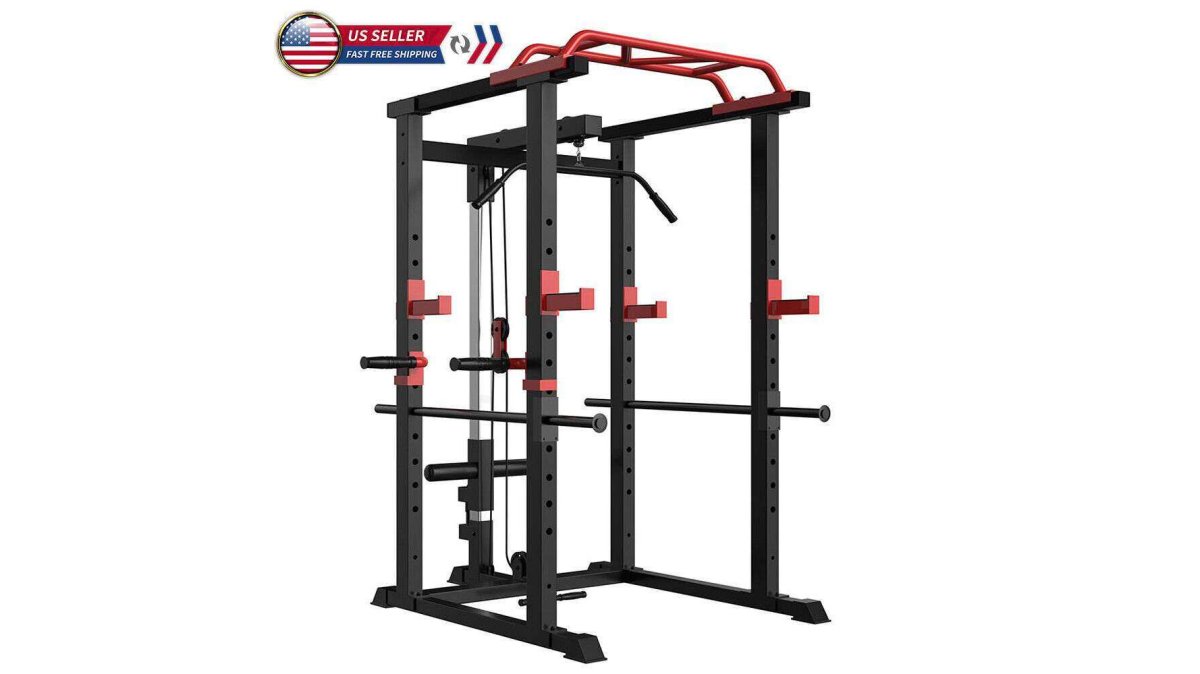
What most reviews miss is the value calculation. At $399.99, this rack replaces a squat stand, pull-up station, and cable crossover in one unit.
Multifunction Home Gym System: Best All-in-One for Small Spaces
The Premium Multifunction Home Gym System is the best all-in-one lifting gear for home gyms when floor space is tight. At $499.99, it combines a 99-lb weight stack with over 35 exercise options, including chest press, lat pulldown, and seated rows.
The adjustable seat and pulley positions accommodate users from beginners to experienced athletes. Its compact footprint makes it ideal for apartments, spare bedrooms, or any area where a full power rack and cable station will not fit.
The tradeoff versus a power cage is ceiling height on overhead movements. A weight stack caps at 99 lb, which suits hypertrophy and toning but not maximal strength work. Pair this system with adjustable dumbbells for a complete setup.
Multi-Functional Strength Training Bench: The Versatile Essential
The Multi-Functional Strength Training Bench is the versatile essential for any home gym. Priced at $219.99, it features 13 adjustable back positions and a thick 10mm steel plate construction for stability during heavy lifts.
A quality bench is the difference between a safe bench press and a shoulder injury waiting to happen. This bench includes leather foam padding and a non-slip handle. The 13 positions support incline, flat, and decline exercises, making it compatible with dumbbell work, barbell presses, and accessory movements.
The bench integrates easily into a home gym setup alongside a power rack. Its compact design suits limited spaces, and the high weight capacity supports your progress as you add plates.
Best Affordable Home Gym Equipment: Building a Budget Setup
The best affordable home gym equipment focuses on compound movements with minimal pieces. You need a rack, a bench, a barbell, and plates. This approach keeps costs down while maximizing training efficiency.
Olympic Weight Bench with Squat Rack: The Budget Powerhouse
The Olympic Weight Bench with Squat Rack at $199.99 is the budget powerhouse of the GearrUp lineup. Constructed from heavy-duty steel, it supports standard Olympic weight plates and includes an adjustable bench with incline, flat, and decline settings.
Its foldable frame design allows for space-efficient storage. Anti-slip feet enhance stability during heavy sets. This bench with squat rack provides an all-in-one workout station without the price tag of a full power cage.
Kettlebells, Weighted Vests, and Other Low-Cost Additions
Budget-friendly home gym equipment extends beyond racks and benches. The Pro-Grip 15 lb Vinyl Kettlebell at $49.99 is a durable functional trainer for swings, squats, and lunges that build conditioning alongside strength. The Adjustable Weighted Vest 12-30 lb at $39.99 adds progressive overload to pull-ups, push-ups, and carries without taking up floor space.
These low-cost additions diversify your training stimulus. Kettlebells build power and cardiovascular health, while a weighted vest increases the difficulty of bodyweight movements.
Must-Have Lifting Accessories for Home: Belts and More
A power rack and barbell are the core of a home gym, but the right accessories make training safer, more effective, and more sustainable. They include gear that protects your body, your floor, and your equipment.
Weightlifting Belts: Support, Not a Crutch
The Pro-Lift PU Leather Weightlifting Belt at $34.99 is our baseline recommendation for anyone pulling or squatting over 80% of their one-rep max. A belt does not lift the weight for you; it provides a rigid wall for your abdominal muscles to brace against (peer-reviewed research). By pushing your core outward into the belt, you increase intra-abdominal pressure, which stabilizes your spine and reduces the risk of a lumbar injury during heavy compound lifts.
For lifters who prefer a consistent thickness around their entire torso, the U-Shaped Weight-Bearing Belt at $39.99 offers a different contour. Its shape accommodates a natural bracing position, which some find more comfortable for overhead presses. The choice between a uniform 4-inch belt and a contoured one often comes down to torso length and personal comfort.
American Council on Exercise guidance on lifting belts notes that proper bracing technique matters more than the belt itself, but a quality belt supports that technique under maximal loads. A belt is a tool for heavy sets, not a back brace for daily wear. Using it for warm-up sets or light accessory work can actually inhibit your core's natural development.
Chalk and Grip Aids: The Unsung Hero
Liquid chalk is a must-have for any home gym. Unlike commercial gyms, you do not have a front desk to borrow chalk from, and sweaty hands on a barbell are a safety hazard. A $10 bottle provides a secure grip for deadlifts, pull-ups, and rows without the mess of loose powder. For lifters whose grip fails before their back on heavy deadlifts, lifting straps or hooks are a worthwhile investment.
Flooring and Protective Mats: Protecting Your Investment
Gym flooring is another essential accessory. Rubber mats protect your floor and equipment when plates drop and reduce noise. The industry standard is a 3/4-inch thick rubber stall mat, often sold at farm supply stores for around $50 per 4x6-foot sheet. These mats absorb the impact of a dropped barbell from overhead. Thinner 1/4-inch mats are fine for light dumbbell work but will not protect against a dropped 45-pound plate from waist height.
Collars and Clips: Non-Negotiable Safety
A set of quick-release barbell collars is a non-negotiable safety item. Spring collars are cheap but often fail to hold plates securely during dynamic movements like cleans or push presses. Locking collars, which use a cam or lever mechanism, provide a secure grip on the sleeve and prevent plates from sliding. A 2-pack of quality locking collars costs between $20 and $40 and is one of the cheapest insurance policies you can buy for your feet and your floor.
The Complete Accessory Stack
For a budget-conscious lifter, the essential accessory list is short: a belt, liquid chalk, a set of locking collars, and a pair of 3/4-inch rubber stall mats. This combination addresses the most common failure points in a home gym, safety, grip, and floor protection, without adding unnecessary clutter. As your training evolves, you can add specialized gear like a deadlift platform or a safety squat bar, but these four items form the foundation of a functional and safe training environment.
How to Choose a Power Rack for Home Gym: Key Specs to Check
Choosing a power rack is not a one-size-fits-all decision. The right rack for a powerlifter is different from the right rack for a CrossFit athlete or a bodybuilder. Most guides list generic specs but fail to match the rack to your training style.
For Powerlifters: Prioritize Stability and Spotter Arms
Powerlifting is about moving maximal weight over a short range of motion. Key specs are a weight capacity of at least 1,000 lb, a steel frame thickness of 11-gauge or thicker, and a footprint that allows for a competition-width stance. The GearrUp Power Cage at $399.99 meets these criteria. The most critical feature is the quality of the spotter arms, they must catch a failed rep without bending. Look for arms at least 2 inches deep with a lip to prevent the bar from rolling off.
For Bodybuilders: Versatility and Cable Attachments
Bodybuilders need a rack that supports a wide variety of angles and accessory movements. A lat pulldown cable station, a low row pulley, and a dip attachment are essential. The Premium Multi-Use Power Cage at $1,499.00 includes a cable crossover system for exercises like tricep pushdowns and face pulls. Check the number of pulley positions and cable smoothness. Prioritize a wide pull-up bar with multiple grip positions to hit the lats from different angles.
For CrossFit and Functional Fitness Athletes: Footprint and Pull-Up Bar Height
CrossFit athletes need a rack that supports explosive movements and high-volume conditioning. The primary concerns are footprint and pull-up bar height. A smaller footprint, like the 43.3" x 55" base of the GearrUp Power Cage, allows more floor space for burpees and kettlebell swings. An 86.6-inch tall rack is sufficient for most athletes under 6 feet tall; taller athletes may need a higher top bar. Plate storage pegs keep plates accessible for quick transitions.
The Universal Specs That Still Matter
Regardless of your training style, three universal specs apply. First, measure your ceiling height from the floor to the lowest obstruction. Second, check the J-hook depth, a shallow hook can allow the bar to tip forward when you re-rack it. Third, consider bolt-down requirements; a rack that is not bolted down needs a wide base and anti-slip feet. The table below summarizes key specs, but your training modality should be the deciding factor.
| Rack Model | Price | Weight Capacity | Footprint | Best For |
|---|---|---|---|---|
| GearrUp Power Cage | $399.99 | 1,000 lb | 43.3" x 55" | Powerlifters and budget-focused lifters |
| Premium Multi-Use Power Cage | $1,499.00 | Heavy-duty steel | Adjustable | Bodybuilders needing cable attachments |
| Olympic Bench with Squat Rack | $199.99 | Olympic plates | Foldable | Small spaces and budget setups |
The real difference between a good rack and a bad one comes down to how it handles a dropped bar. A quality rack catches the weight without bending. Steel thickness and weld quality should drive your decision more than any other factor, but matching the rack to your training style is what makes it right for you.

Frequently Asked Questions
What is the essential lifting gear for a beginner home gym?
Start with a power rack or squat stand, an adjustable bench, a barbell, and weight plates. These four pieces cover compound movements like squats, bench presses, and rows. For a budget-friendly start, the GearrUp Olympic Weight Bench with Squat Rack combines two essentials in one unit. Add a pair of adjustable dumbbells and resistance bands as you progress.
How much space do I need for a home lifting setup?
A power rack with a 43.3" x 55" footprint, like the GearrUp Power Cage, fits in a standard garage bay or spare room. Plan for 2 feet of clearance on each side for loading barbells and at least 6.5 feet of ceiling height for overhead presses. A compact multifunction gym system with a 99-lb weight stack suits tighter spaces.
Is it better to buy a home gym package or individual lifting gear?
Packages save money and simplify assembly, making them ideal for most home lifters. The GearrUp Premium Multifunction Home Gym System includes over 35 exercises in one frame. Individual pieces offer more flexibility for specialized goals like powerlifting. If you plan to compete in powerlifting, buying a power rack, Olympic bar, and plates separately gives you competition-specific gear.
What safety equipment is necessary for lifting heavy at home?
Safety arms or spotter bars on your power rack are non-negotiable for bench presses and squats. A weightlifting belt, like the Pro-Lift PU Leather option, supports your core during heavy compound lifts. Rubber gym flooring protects both your floor and your equipment. Always use collars on your barbell to keep plates secure.
Choosing the right lifting gear for your home gym is a balance of space, budget, and training goals. Start with a power cage or bench that covers your compound movements, then add accessories as your strength grows. GearrUp builds precision-crafted equipment with fair prices and free shipping, and our easy returns mean you can buy with confidence. Shop the full equipment lineup and start training the way you have always wanted.
This article was written using GrandRanker

