

Table of Contents
- Quick Comparison: Best Knee Braces for Working Out
- How to Measure Your Knee for a Brace
- Knee Compression Sleeve vs Brace: Which One Do You Need?
- When to Wear a Knee Brace During Exercise
- Top Picks for the Best Knee Brace for Working Out
- Post-Workout Recovery and Skin Care for Brace Wearers
- Frequently Asked Questions
Last Updated: September 23, 2026
Quick Comparison: Best Knee Braces for Working Out
The right best knee brace for working out depends on what your knee needs: a light compression sleeve for warmth and mild swelling, a patellar strap for anterior knee pain, or a structured guard for impact protection. At GearrUp, we've built our line around that split, because one brace cannot serve a runner with tendonitis and a lifter moving heavy squats.
Here's the short version before the detail:
| Product | Price | Support Level | Best For |
|---|---|---|---|
| Compression Sport Knee Brace | $15.99 | Mild to moderate | General training, swelling control |
| Pro-Guard Dual Patella Knee Strap | $14.99 | Moderate, targeted | Patellar tracking, anterior knee pain |
| Patellar Support Strap | $10.99 | Moderate, targeted | Runner's knee, budget buyers |
| Pro-Guard Knee & Elbow Protection Set | $18.99 | Impact protection | Contact sports, floor work |
How to Measure Your Knee for a Brace
Sizing is where most people get this wrong: the brace feels secure in front of a mirror, then migrates the moment you load the joint. Measure the way the brace will actually be worn, under tension, on a straight leg, at the manufacturer's landmarks.

The measurement protocol
Use a soft tailor's tape, not a rigid ruler, and measure bare skin or thin fabric, never over leggings or sweatpants, which can add half an inch or more and push you into the wrong size.
- Mid-patella circumference. Stand with the leg fully extended and the quad relaxed. Wrap the tape around the center of the kneecap, level all the way around. Most strap-style and open-patella braces are built around this number.
- Above-patella circumference. Measure two inches above the top of the kneecap. Sleeve-style and hinged braces with a proximal strap use this number, because the upper anchor keeps the brace from sliding down during squats.
- Below-patella circumference. Measure two inches below the bottom of the kneecap. This matters most for patellar straps, which need to sit just under the patella without pinching the tibial tuberosity.
- Thigh circumference at mid-thigh. Measure halfway between the kneecap and the groin. This predicts whether a long sleeve will roll down during running or cycling.
Reading a sizing chart correctly
A range like 13.8 to 21.7 inches (35 to 55 cm) is the span over which the strap's hook-and-loop closure still generates meaningful tension. At the bottom the pad sits high; at the top it sits low. Within an inch of either end, expect to adjust pad position, not just strap length.
Fit-failure diagnostics
If your brace does any of the following, the problem is almost always sizing, not the product:
- Sliding down during squats or lunges. The above-patella anchor is too loose, or the sleeve has stretched past its recovery point. Re-measure the upper circumference.
- Bunching behind the knee. The brace is too long for your femur length, or the below-patella strap is too tight, the most common cause of the pinching sensation people describe as 'the brace fighting me.'
- Pinching at the sides of the kneecap. The patellar opening is too small. This is a shape mismatch, not a size mismatch, and no strap adjustment will fix it.
- Numbness or tingling in the foot or toes. The brace is compressing the popliteal artery or peroneal nerve. Remove it immediately and size up.
- Red marks that persist more than 30 minutes after removal. Compression is too high. Back the strap off one notch or move to a larger size.
When to re-measure
Re-measure after a change of more than about five pounds of body weight, after detraining, and after roughly six months of regular use, elastic loses recovery, and a brace that fit in January may be a size too large by summer. In hot climates or with heavy sweating, replace sleeves more often than straps.
Knee Compression Sleeve vs Brace: Which One Do You Need?
The sleeve-versus-brace question is a load-management question. A compression sleeve changes the environment around the joint, warmth, blood flow, proprioceptive feedback, without changing how it moves. A structured brace changes the mechanics with straps, hinges, or pads that alter tracking, limit range of motion, or redistribute force. Knowing which lever you need is the whole decision.
What each option actually does
Compression sleeves apply uniform circumferential pressure, typically 15 to 25 mmHg for athletic products. That pressure increases local tissue temperature, improves venous return to reduce next-day swelling, and stimulates mechanoreceptors in the skin and joint capsule, which is why many lifters report better 'feel' for knee position under load. A sleeve does not change patellar tracking or stabilize a ligament.
A decision framework by injury and activity
| Situation | Best fit | Why |
|---|---|---|
| Mild swelling, no pain, want warmth | Compression sleeve | Uniform pressure, no motion restriction |
| Anterior knee pain on stairs or after runs | Patellar strap | Targeted tendon offloading |
| Patellar tracking issues during squats | Sleeve with patellar buttress or open-patella brace | Keeps the kneecap centered without limiting depth |
| Mild MCL or LCL irritation | Hinged brace with side stays | Resists valgus or varus load |
| Post-operative or significant instability | Prescribed hinged brace | Follow the surgeon's or PT's protocol, not a retail pick |
| Contact sport or mat work | Padded knee guard | Impact protection, not joint support |
| Heavy squatting with no pain history | Sleeve or nothing | A brace manages load; it does not build capacity |
The load-management principle
A brace manages load; it does not build the quad, glute, and hamstring strength that keeps the kneecap tracking properly in the first place. This is the point the American Academy of Orthopaedic Surgeons patient guidance on knee bracing makes: bracing supports, it does not substitute for rehabilitation. The practical implication is that a brace should let you train the tissue you need to strengthen, not replace that training.
Layering braces with other gear
A brace that fits perfectly on bare skin can bunch, migrate, or restrict circulation once you add leggings, a lifting belt, or knee wraps.
- Under leggings. Wear the brace against the skin and the leggings over it. A brace over leggings slides because fabric-to-fabric has less friction than fabric-to-skin. If you must wear it over leggings, choose a silicone-grip band and expect to re-adjust between sets.
- With a lifting belt. The belt sits at the waist, well above the knee, so there is no direct conflict, but a high-top sleeve can bunch behind the knee in a deep squat. If that happens, drop to a shorter sleeve or an open-patella design.
- With knee wraps. Do not wear a sleeve and wraps on the same knee. Wraps are applied at high tension for a short, heavy set; a sleeve underneath changes the contact points and can create pressure ridges. Pick one.
- With compression tights. A sleeve over compression tights is redundant and tends to roll. If your tights already provide compression, skip the sleeve and use a strap or structured brace instead.
- With shoes and socks. A tall sock under a sleeve adds bulk at the calf and can push the sleeve down. Wear a low sock or no sock under the brace.
The short version
Choose a sleeve for warmth, mild swelling, and proprioception; a strap for anterior knee pain; a structured or hinged brace for ligament support or impact protection. Layer any of them against the skin, under your other gear, so nothing slides, bunches, or cuts off circulation mid-set.
When to Wear a Knee Brace During Exercise
Wear a knee brace during exercise when you have a diagnosed or suspected strain, a history of patellar tracking issues, or a movement pattern that repeatedly provokes pain. Take it off for low-load days, and don't wear it every session out of habit.
The practical rules:
- Wear it for squats, lunges, running, and sport if a clinician or your own history points to a specific problem
- Skip it during warm-up mobility work, which you want unrestricted
- Skip it on easy days if you're pain-free, so you don't become dependent on external support
- Never use a brace to push through sharp pain
Top Picks for the Best Knee Brace for Working Out
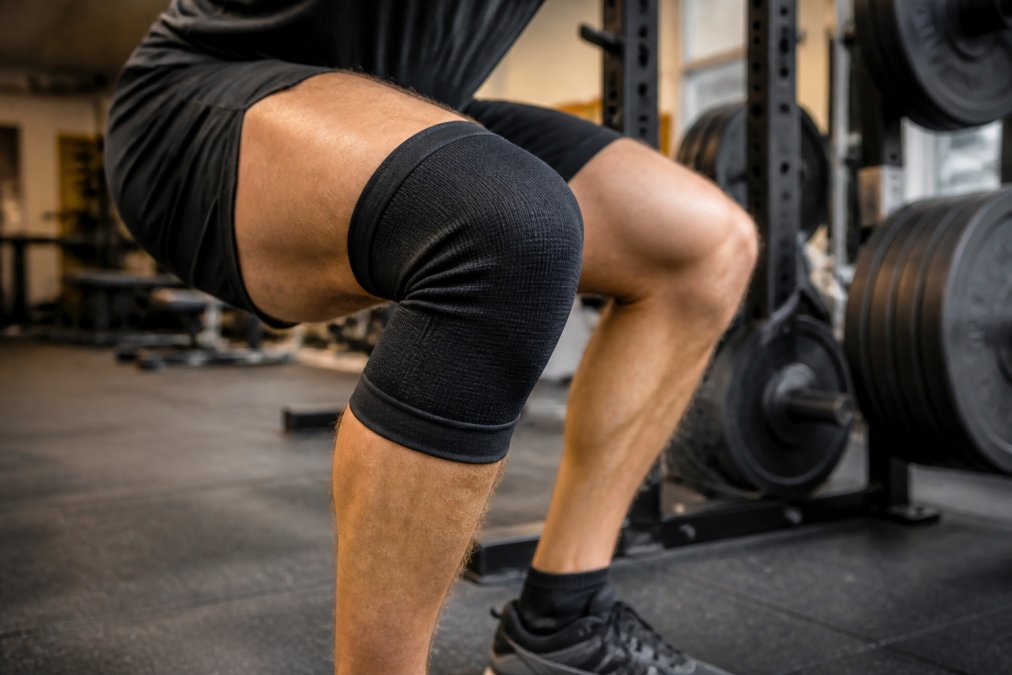
GearrUp's Compression Sport Knee Brace is our top pick for most lifters and general trainees: breathable mesh and adjustable straps cover the widest range of sessions without limiting squat depth. At $15.99, it's the one to start with if you're unsure what you need.
1. Compression Sport Knee Brace - Breathable Support ($15.99)
2. Pro-Guard Dual Patella Knee Strap ($14.99)

3. Patellar Support Strap - Knee Stability Brace ($10.99)
4. Pro-Guard Knee & Elbow Protection Set ($18.99)
Post-Workout Recovery and Skin Care for Brace Wearers
Skin irritation is the most common complaint among regular brace wearers, and it's almost always moisture and hygiene rather than materials. Sweat trapped under neoprene softens the skin, friction does the rest, and within a week you have a rash exactly where the strap sits.
What works:
- Wash the brace after every heavy session, by hand, in cold water with mild soap
- Air dry completely before it goes back in your bag, since damp neoprene grows bacteria fast
- Shower and dry the skin before reapplying anything
- Rotate two braces if you train daily, so one is always fully dry
- Stop wearing it immediately if you develop a persistent rash, and let the skin recover
Frequently Asked Questions
Is it good to wear a knee brace while working out?
Yes, if you have knee pain, instability, or a history of injury. A knee brace can improve proprioception, support joint alignment, and reduce strain during squats, lunges, or running. However, healthy knees without symptoms don't need one for every session. Use a brace when you feel discomfort or need extra confidence under load, and remove it afterward to let your muscles work naturally.
Should I use a compression sleeve or a hinged knee brace for lifting?
For mild support and warmth during lifting, a compression sleeve works well. If you need lateral or medial stability after an injury, a hinged brace is better. GearrUp's Compression Sport Knee Brace ($15.99) offers breathable compression for general workouts. For patellar tracking issues, the Pro-Guard Dual Patella Knee Strap ($14.99) targets the kneecap without restricting range of motion. Choose based on your injury history and how much stability you need.
How do I know if I need a knee brace for exercise?
You may need a knee brace if you experience pain during squats, running, or lunges, feel the knee giving way, or have swelling after activity. A brace helps with patellofemoral syndrome, meniscus support, and ligament stability. If pain persists beyond two weeks or limits daily movement, see a healthcare professional. For mild discomfort, a patellar strap or compression sleeve can provide relief during workouts.
How do I measure my knee for a brace?
Use a soft measuring tape around the center of your kneecap, keeping the leg straight but relaxed. Note the circumference in centimeters. For straps, measure just below the kneecap. Compare your measurement to the product's size range. GearrUp's Pro-Guard Dual Patella Knee Strap fits 35 cm to 55 cm, while the Sports Elbow Guard adjusts from 25 cm to 40 cm. Always check the specific product guide before ordering.
What is the best knee support for going to the gym?
The best support depends on your activity. For general gym work and mild pain, a compression sleeve like GearrUp's Compression Sport Knee Brace ($15.99) provides breathable support and promotes circulation. For patellar tendon issues, the Linear Patellar Support Strap ($10.99) offers targeted compression. If you need impact protection for contact sports, the Pro-Guard Knee & Elbow Protection Set ($18.99) includes knee guards with honeycomb padding. Match the brace to your specific need.
Knee pain shouldn't decide whether you train. GearrUp builds precision-crafted support gear for people who want to keep moving, with breathable materials, adjustable fits, and prices that don't punish you for needing a brace. Our Compression Sport Knee Brace, Pro-Guard Dual Patella Knee Strap, and Pro-Guard Protection Set cover mild support through impact protection, backed by free shipping, secure payment, and easy returns. SHOP EQUIPMENT and get back under the bar.

